
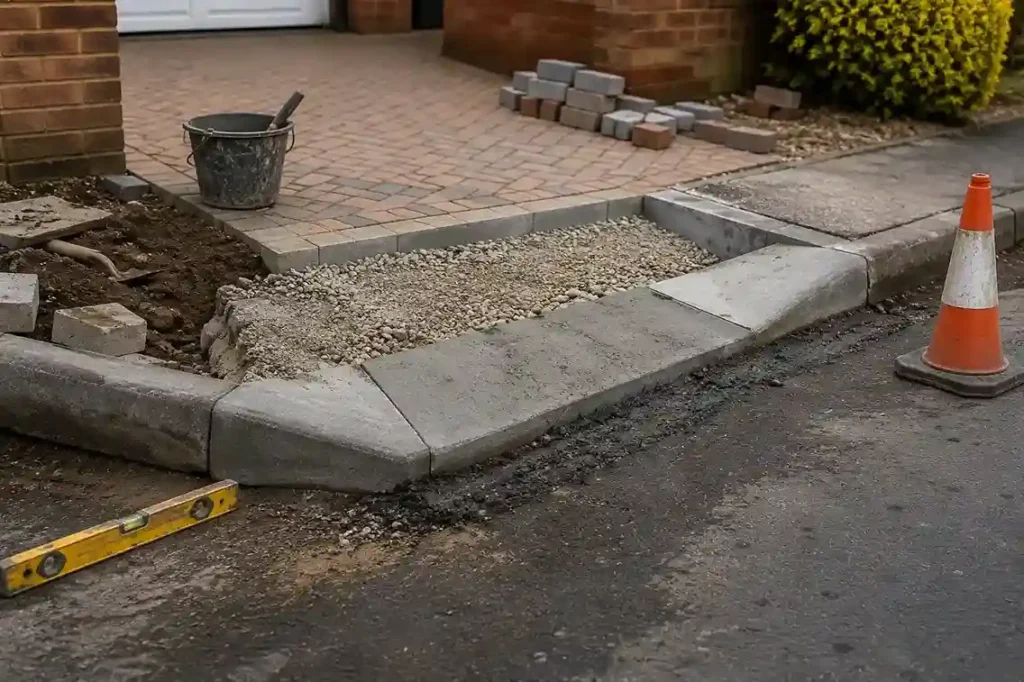
We’ve all looked at a job and thought, How hard can it be? Sometimes we’re right — flat-pack furniture, a bit of painting, a dripping tap. But some jobs really do need a professional, and installing a dropped kerb is one of them. At Driveways Durham, we see it all the time. A homeowner tries to save a few hundred pounds, then months later they’re calling us to fix it — often for more than a pro would’ve cost, sometimes with a council fine too. So before you start, let’s look at the common mistakes DIY dropped kerb installers make.
First, the Big One: Skipping Council Permission
Here’s the mistake that catches more DIYers than any other — and it’s a serious one. Every single dropped kerb in Durham requires permission. You cannot legally lower a kerb or cross a public footpath to access your property without an approved application. This isn’t optional, and it isn’t a grey area.
Why It Matters
The pavement and kerb outside your home belong to the highway authority — Durham County Council — not to you. Lowering it without a Section 184 application is illegal, and the consequences are real:
- The council can order you to reinstate the kerb at your own cost
- You can be fined
- Any damage to utilities (gas, water, telecoms) under the pavement becomes your liability
- It can flag up and complicate things when you sell your house
DIY installers often don’t even know this permission exists until a council inspector knocks on the door. By then, the concrete’s already set.
Quick tip: Only contractors on the council’s approved list can carry out the work on the highway itself. That alone rules out almost every DIY attempt.
The Practical Mistakes That Wreck the Job
Even setting aside the legal side, the physical installation is where most DIY dropped kerbs fall apart — often literally.
1. Getting the Sub-Base Wrong
This is the single most common technical failure we’re called out to fix. The sub-base is the layered foundation beneath the kerb and surface, and it’s what carries the weight of your car day after day.
DIYers typically:
- Don’t dig deep enough (you need a proper excavation, not a scrape)
- Skip the MOT Type 1 aggregate or use the wrong material
- Fail to compact each layer with a wacker plate
- Forget the sub-base needs to extend beyond the kerb itself
The result? The kerb sinks, cracks, or breaks under the weight of a vehicle within months.
2. Ignoring Drainage and Levels
Get the gradient wrong, and you create a dam. We’ve seen DIY kerbs that funnel every drop of rain straight toward the house — or worse, onto the neighbour’s property. Water pooling on the pavement is also a council violation and a genuine hazard in our frosty winters, when it turns to sheet ice overnight. A professional sets precise falls so water drains exactly where it should. It’s millimetre work, and it’s easy to get wrong by eye.
3. Damaging Underground Utilities
Beneath that innocent-looking pavement runs a tangle of gas pipes, water mains, electricity cables, and telecoms. Professionals carry out checks and know how to dig safely. A DIYer with a hired digger and no plans is one careless scoop away from a very expensive — and very dangerous — accident.
4. Using the Wrong Materials
Standard patio blocks are not rated for vehicle loads. Neither is thin domestic tarmac. We regularly see DIY kerbs laid with materials that simply weren’t built to take the weight of a car crossing them dozens of times a week. They crumble at the edges, pit, and fail fast.
5. Poor Kerb Setting and Bedding
Kerbs need to be bedded on the right mortar mix and properly haunched (supported) behind. Skimp here and the kerbs creep, tilt, and separate. It’s the kind of detail that looks fine on day one and disastrous by the following spring.
The Saving Money Myth
Here’s the maths that catches people out. A DIY dropped kerb might feel cheaper upfront — you’ve saved on labour, after all. But factor in:
- Tool and digger hire (£150–£300+)
- Materials you’ll likely buy wrong at least once
- Skip hire for the spoil
- The council application you still legally need
- The very real chance of reinstatement costs if it’s done wrong
- Repair or full redo when it fails
Suddenly, that saving has evaporated — and you’ve spent a fortnight of weekends on it too. A professionally installed dropped kerb in Durham, done once and done right, almost always works out better value over its 20+ year lifespan.
How the Professionals Do It Differently
When Driveways Durham handles a dropped kerb, the process looks nothing like a weekend DIY scramble:
- Site survey: We assess levels, drainage, and access
- Council application: We handle the Section 184 paperwork for you
- Utility checks: Safe excavation, no nasty surprises
- Proper sub-base: Correct depth, correct aggregate, fully compacted
- Correct materials: Rated for vehicle loads, built to last
- Precise finishing: Accurate falls, neat reinstatement, council sign-off
It’s the unseen work — the foundation, the levels, the paperwork — that separates a kerb lasting two decades from one failing in two winters.
The Honest Bottom Line
We’re not here to scare you off doing your own jobs — plenty of home improvements are perfect weekend projects. But a dropped kerb sits on public land, carries the weight of your car every day, and comes with legal obligations most people don’t even know exist. The mistakes DIY installers make aren’t small ones; they’re the kind that cost real money and real hassle to put right. On top of that, many homeowners underestimate how weather affects dropped kerb installation, such as heavy rain. Freezing temperatures and poor ground conditions can weaken the structure and delay the work.
Get It Right First Time with Driveways Durham
At Driveways Durham, we’ve fixed enough DIY dropped kerbs to know exactly where they go wrong — and we’d much rather save you the cost and stress by doing it properly from the start. We’re a local, experienced team. We handle the council application, the safe excavation, the right materials, and the proper finish, all backed by workmanship you can trust.
Frequently Asked Questions (FAQs)
Can I legally install a dropped kerb myself in Durham?
You can apply, but the actual work on the public highway must be carried out by a contractor approved by Durham County Council. In practice, this means DIY installation onto the highway isn’t permitted. You can read the rules on the Durham County Council website.
What happens if I install a dropped kerb without permission?
The council can require you to reinstate the pavement at your own expense, issue a fine, and you’ll be liable for any utility damage. It can also cause problems when selling your home.
How much does a professional dropped kerb cost in Durham?
It varies with size, materials, and groundwork needed — but a professional install removes the hidden costs and risks of DIY. For exact figures, see our related guide on dropped kerb installation in Durham or request a free quote.
Why do DIY dropped kerbs fail so often?
Usually because of poor sub-base preparation, incorrect drainage falls, and using materials not rated for vehicle weight. These faults often don’t show until months later — then they’re expensive to fix.
Is it really cheaper to hire a professional?
Over the lifespan of the kerb, almost always yes. One correct installation beats paying twice — once for the failed DIY attempt, again for the proper repair.


